Bathrooms · Valencia
Watertight bathroom renovations in Valencia, finished to last
Waterproofing, pipework and ventilation resolved properly — the bathroom you will not be pulling apart again in five years. We have been building here for 35+ years, from a yard in La Eliana, with our own plumbers and tilers, a fixed written quote and every step of it explained to you in English.
Get my bathroom pricedCall · +34 632 224 555The bathroom is the smallest room in the house and, oddly, the easiest one to get wrong. In four or five square metres you bring together water, drainage, electricity and permanent humidity, and nearly everything that decides whether it lasts — the waterproofing, the falls, the pipework — ends up buried under the tiles. When that part is rushed you do not see it on handover day. You see it six months later, as mould in the joints, a lifted edge or a damp patch on the ceiling of the flat below. We have spent more than 35 years renovating bathrooms in Valencia, La Eliana and the Camp de Túria, and we look after what you cannot see as carefully as what you can.
Most of these bathrooms are in houses somebody is living in while we work, so the job is planned around that. Rather than you chasing a plumber, a tiler and a screen fitter who have never met each other, a single site manager sets the order, books each trade and tells you where things stand. You pick the sanitaryware and the finishes. We make sure the room comes back on the day we said, for the price we agreed, and with the fewest days out of use we can manage.
Whether you want to swap the bath for a walk-in shower, get more out of a small bathroom, adapt one for an older relative, or strip it back and start again, this is the page for it. If the work runs past the bathroom door, we also take on full home renovations and partial renovations, room by room.
01 A complete service
What a bathroom renovation includes
A genuinely new bathroom, from the waste pipe to the last joint — not a facelift that looks well for two summers.
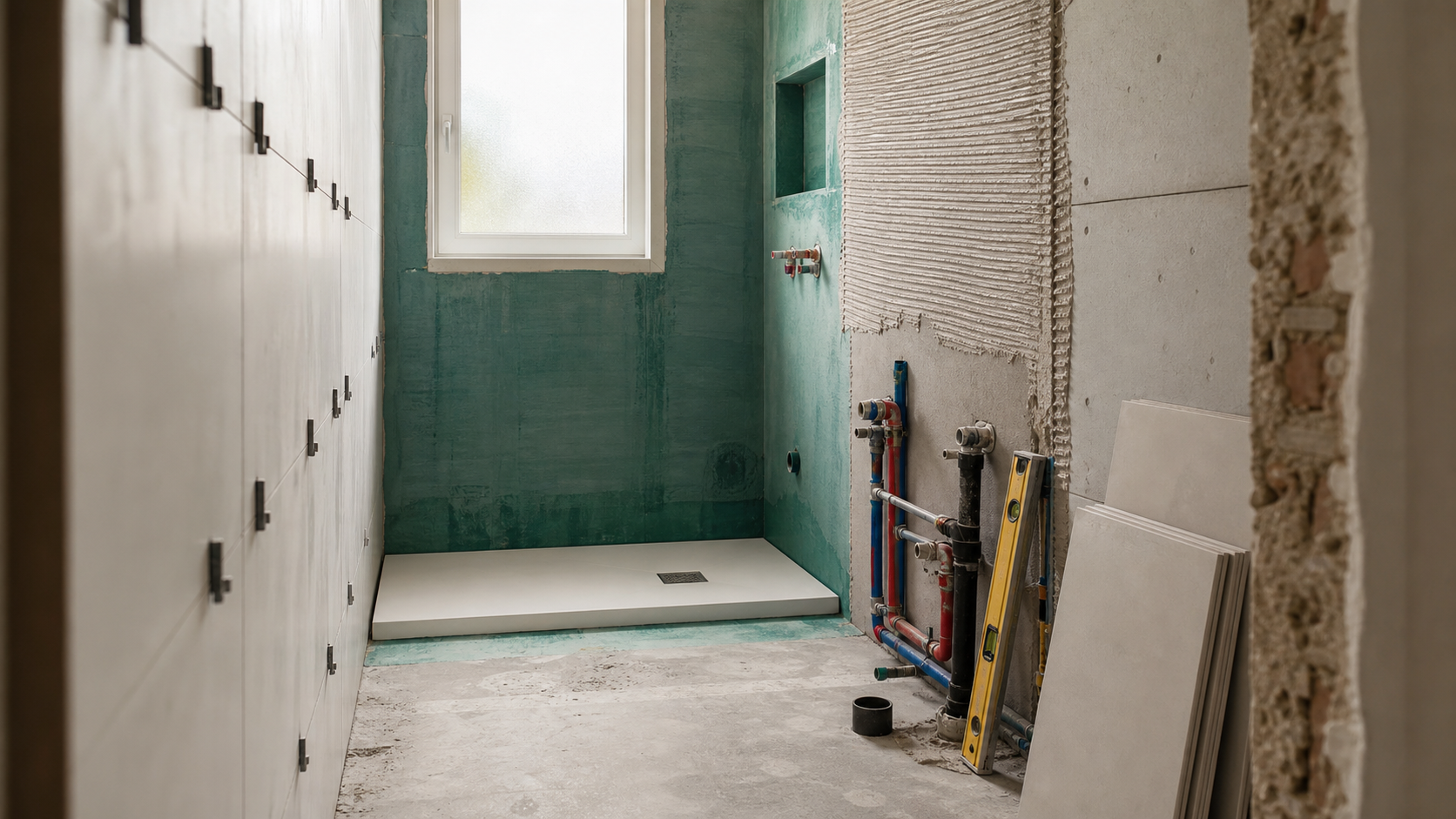
Strip-out and building work
Out come the old sanitaryware, the tiling and the tray. We take the rubble away and leave walls and floor sound, so the new bathroom starts on a proper base.
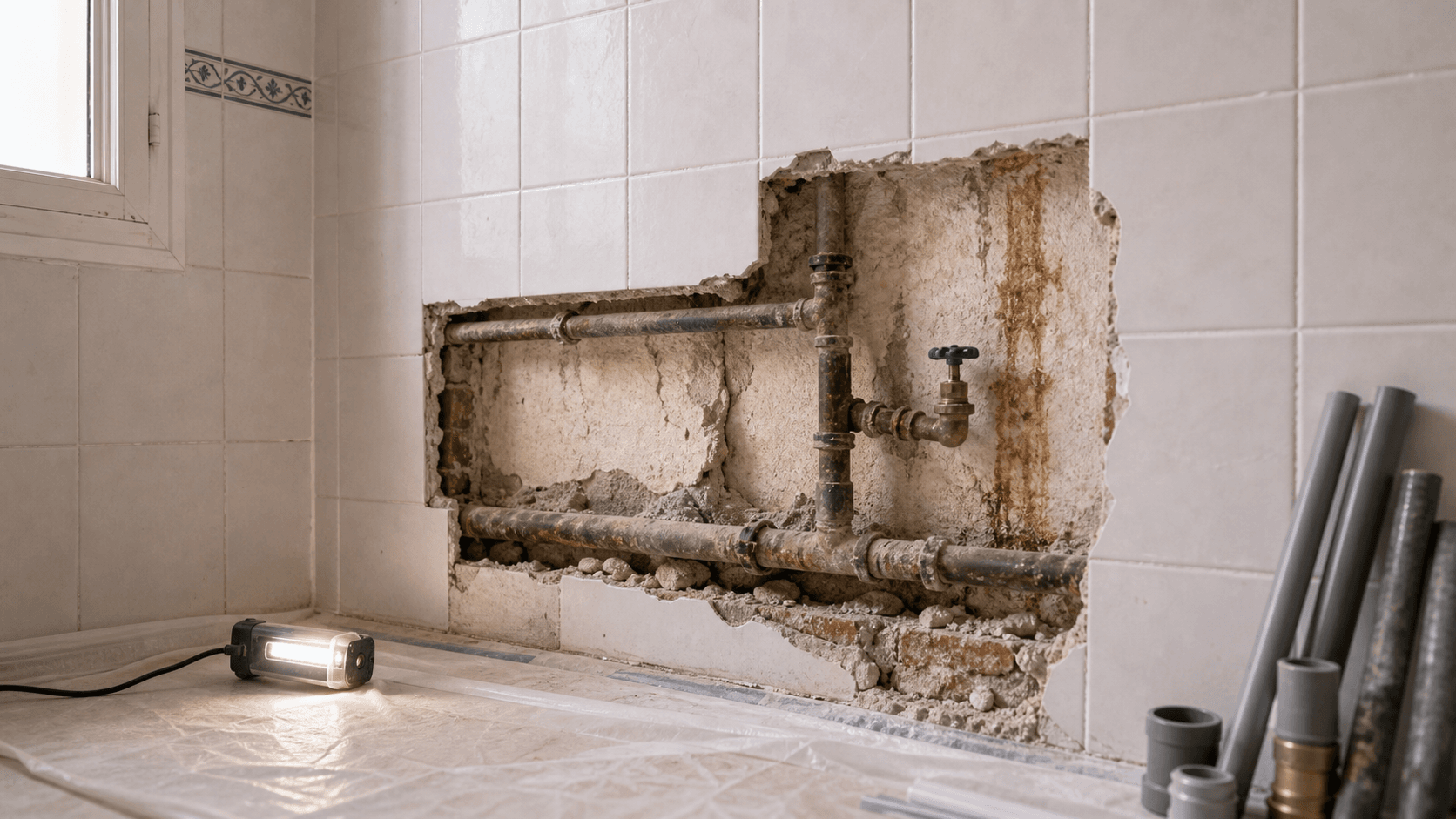
Plumbing and waste
Supply pipes, waste and sanitaryware — toilet, basin, bidet — renewed while the walls are open. That is the moment to do it, not five years from now.
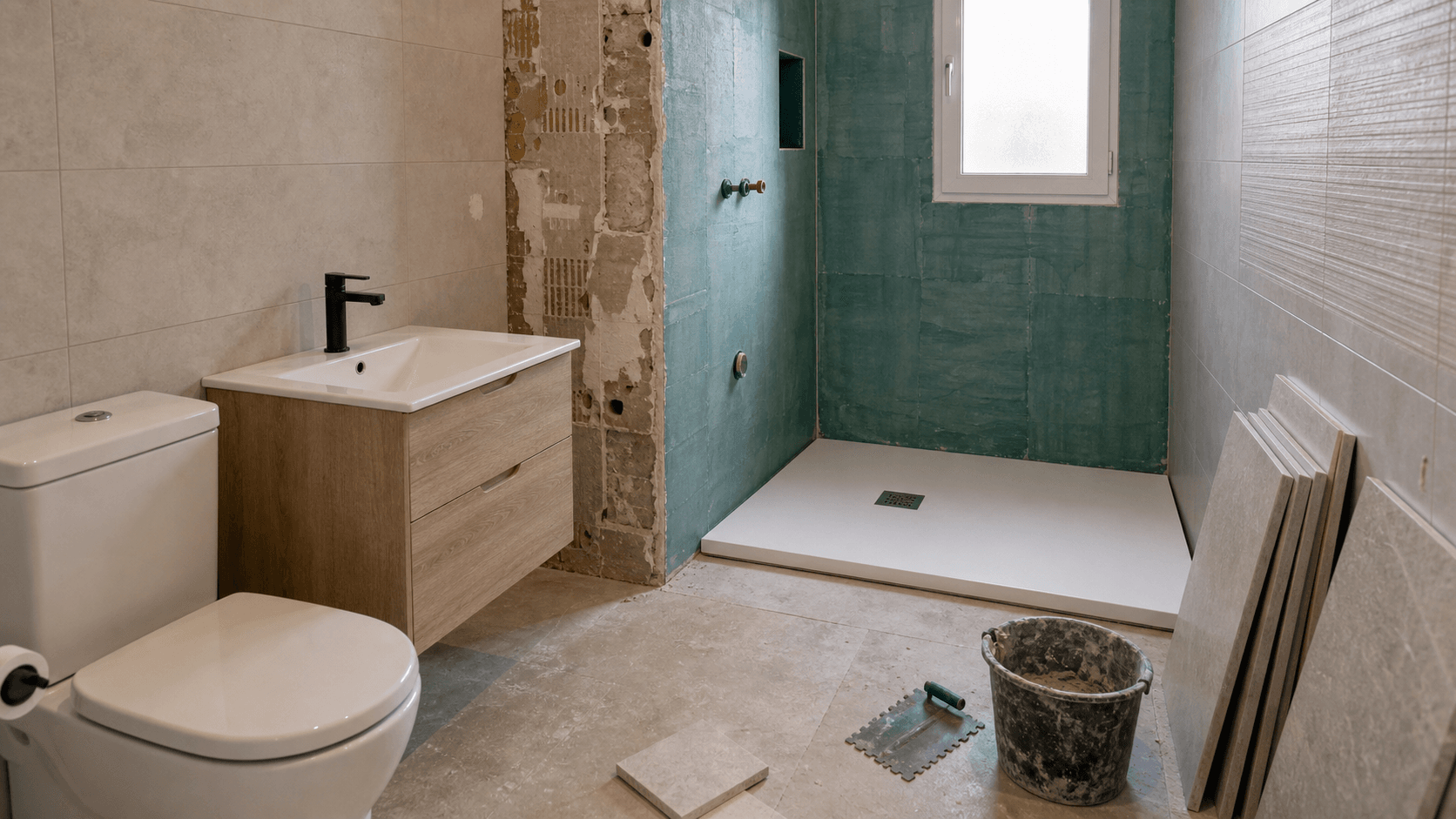
Shower and screen
The bath goes and a flush-fitted, anti-slip tray takes its place, with a made-to-measure screen and thermostatic taps you set once and forget.
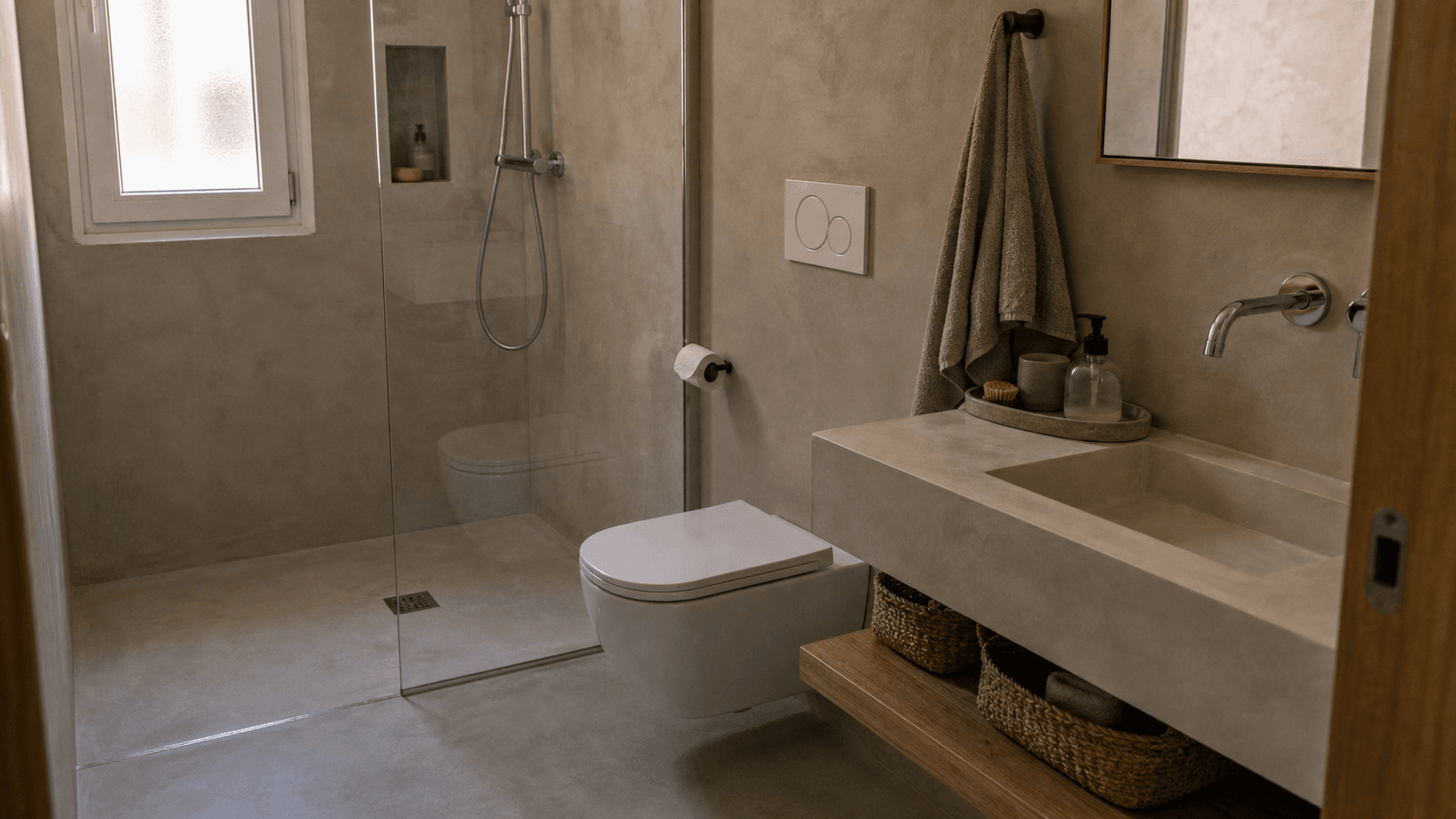
Tiling and floors
Porcelain, large format or microcement, always laid over waterproofing that was done properly under the tray and behind the wall finishes.
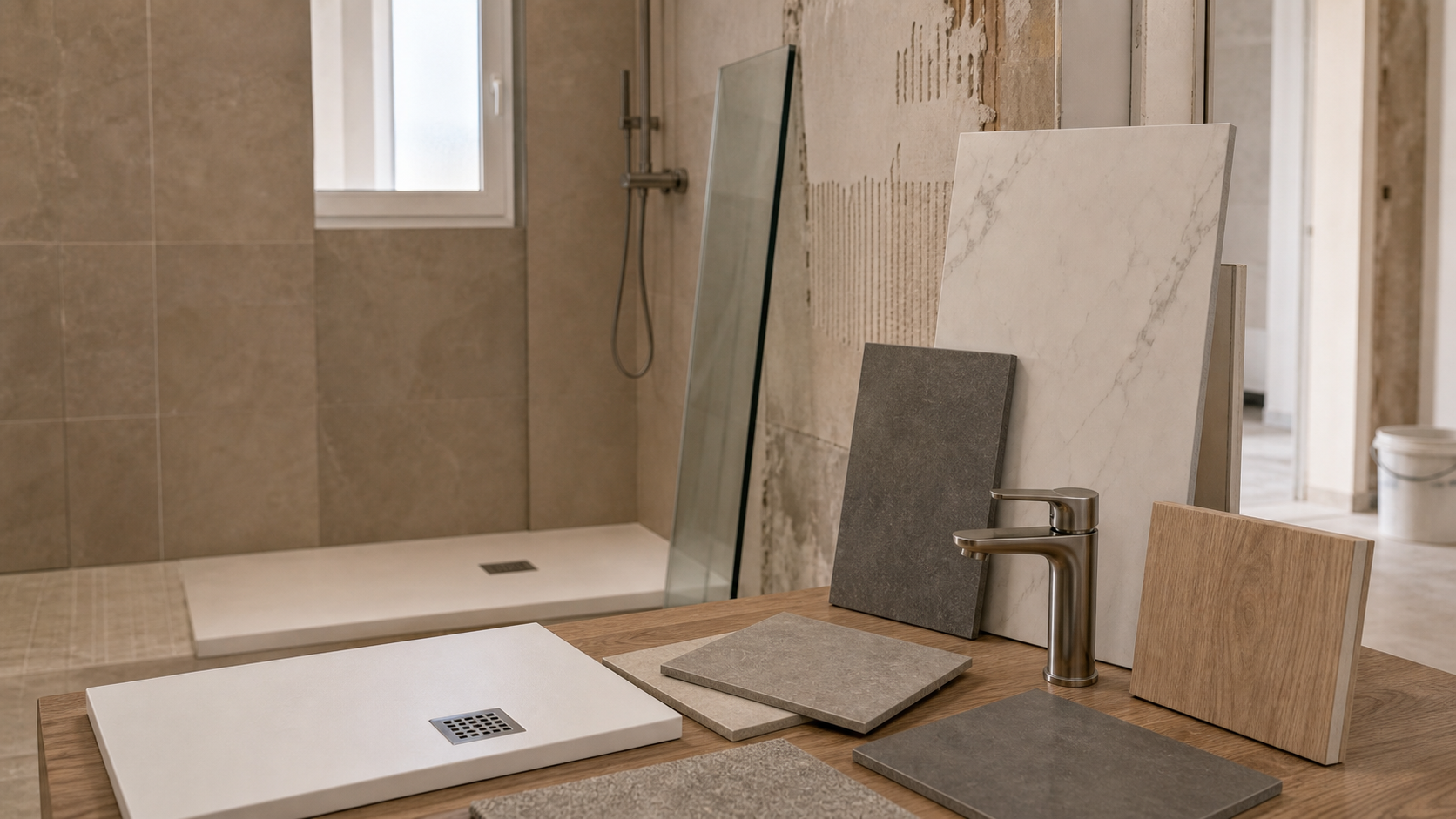
Furniture and lighting
Wall-hung units, basins, mirrors with light built in, a towel rail and lighting that is warm to sit under and bright enough to shave by.
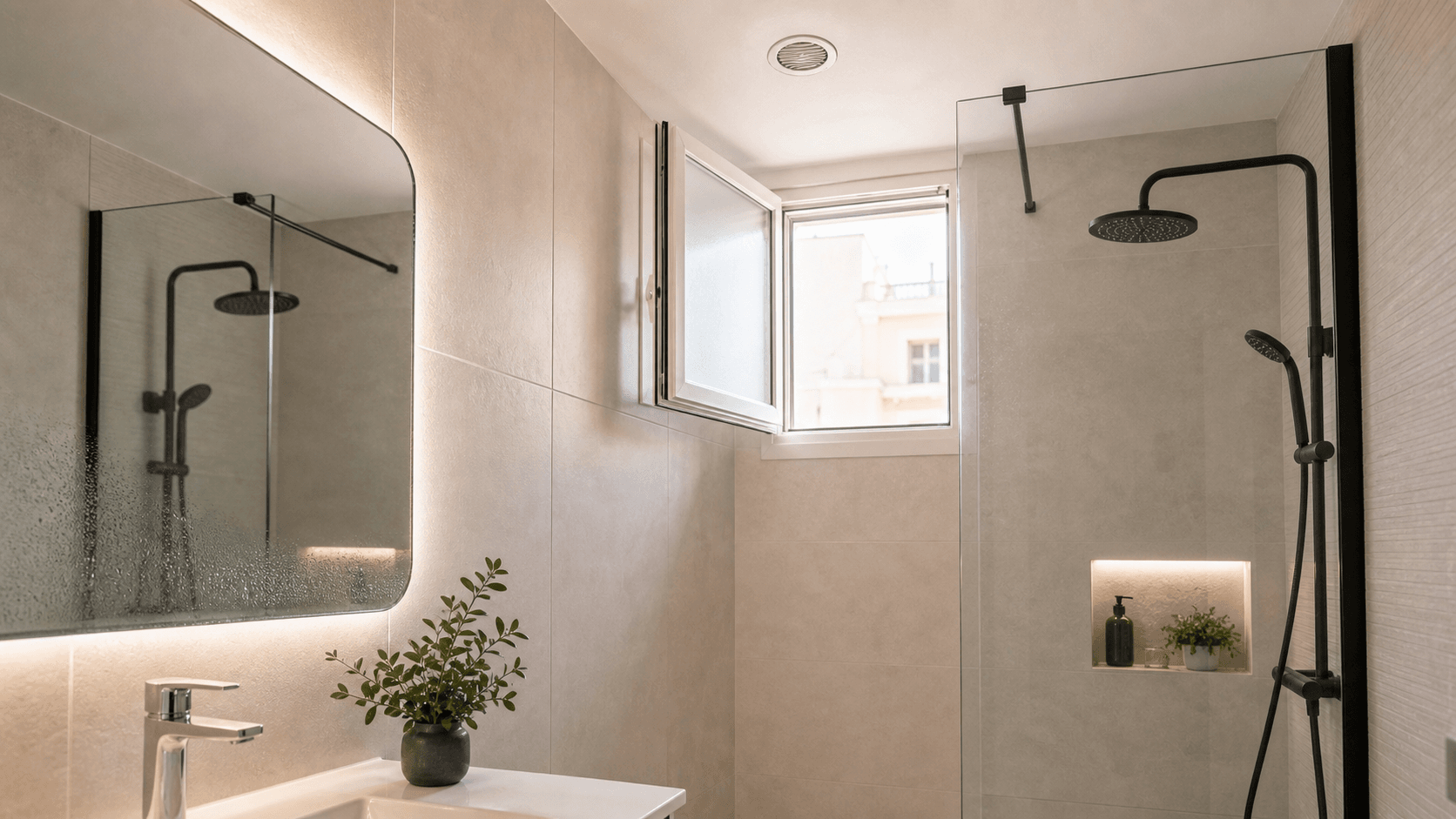
Ventilation and damp
Extraction sized for the room so condensation and mould do not come back once the job is finished. It is part of the work, not an afterthought.
Doing the kitchen in the same visit? There is a page for kitchen renovations, and if the work covers the whole house, for full home renovations. Where the bathroom sits in a detached house with two or three of them, villa renovations takes the lot as one job.
By scope
Types of bathroom renovation: from a shower swap to a complete refurbishment
Not every bathroom starts from the same place or costs the same. Knowing which of these three you are actually asking for saves you money before anybody quotes, because it stops you paying for work you did not need.
Swapping a bath for a walk-in shower
The one we are asked for most, and the most contained. Out comes the bath, we prepare the base, waterproof it and fit a flush-fitted shower tray with its screen. A few days’ work, without touching the rest of the room, and it buys you safety and floor space for a modest figure. It is the obvious move if what you want is to lose the step you have to climb over without taking on a proper job.
Complete bathroom refurbishment
The room comes back new: pipework, sanitaryware, tray, tiling, flooring, furniture and lighting. This is the renovation for a bathroom that is already giving trouble or simply looks its age. While everything is open, it is worth checking the supply pipes and the waste — going back in later means breaking up tiling you have just paid for.
Renovation with a new layout
The furthest-reaching version: on top of renewing everything, the shower, toilet or basin move, a shower room appears where a box room used to be, or a bathroom with a bath becomes one with twin basins. More plumbing, sometimes a partition wall down, and by far the most planning. When it drags in the rooms next door it usually belongs inside a full home renovation.
02 Your bathroom
Choose your situation
Every bathroom arrives with a different problem attached. These are the four we see most around Valencia and the Camp de Túria — open the one that sounds like yours.
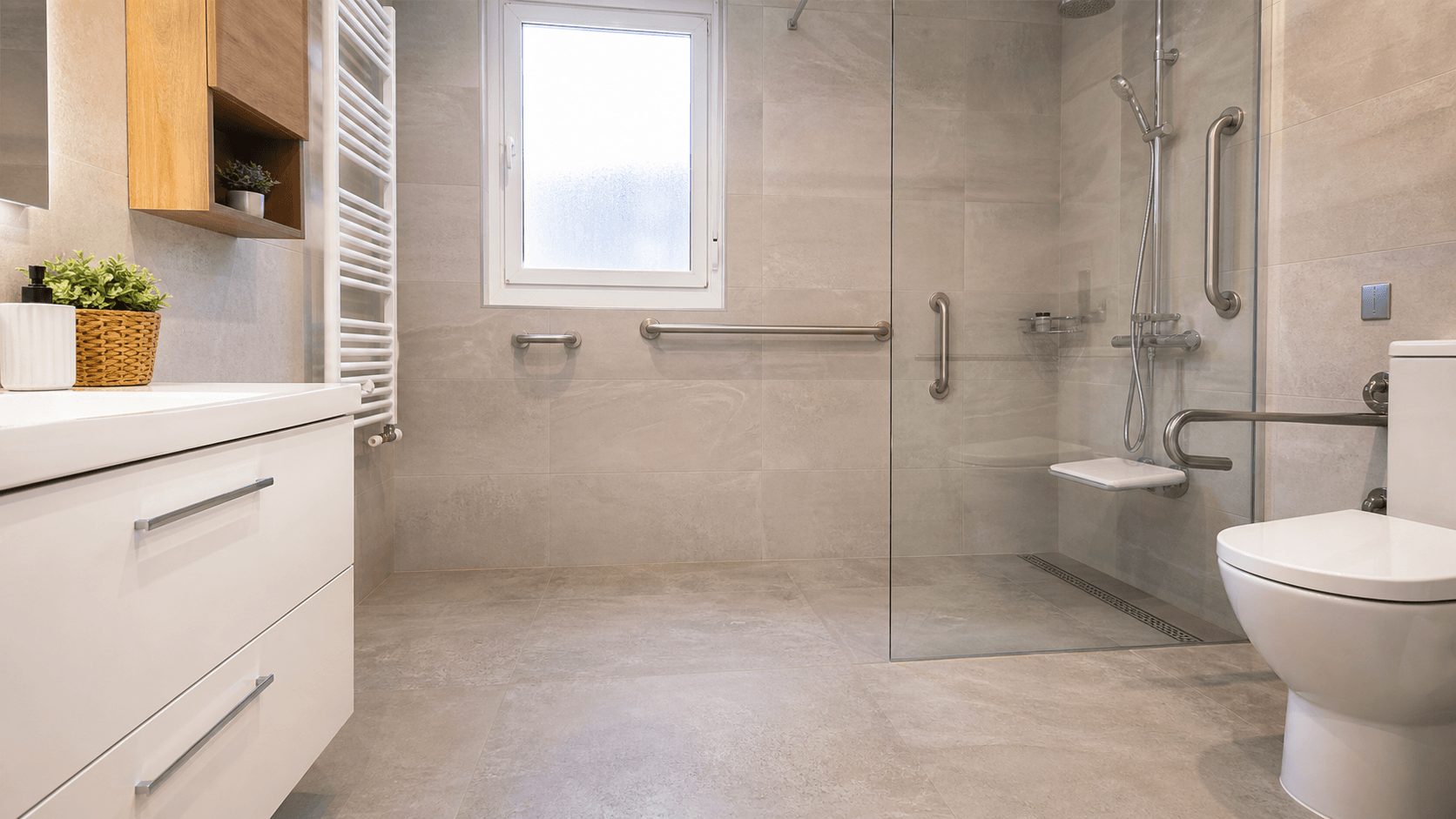
Swap a bath for a shower
You want the bath out and a comfortable walk-in shower in. The tricky part: the waterproofing and the fall to the waste.
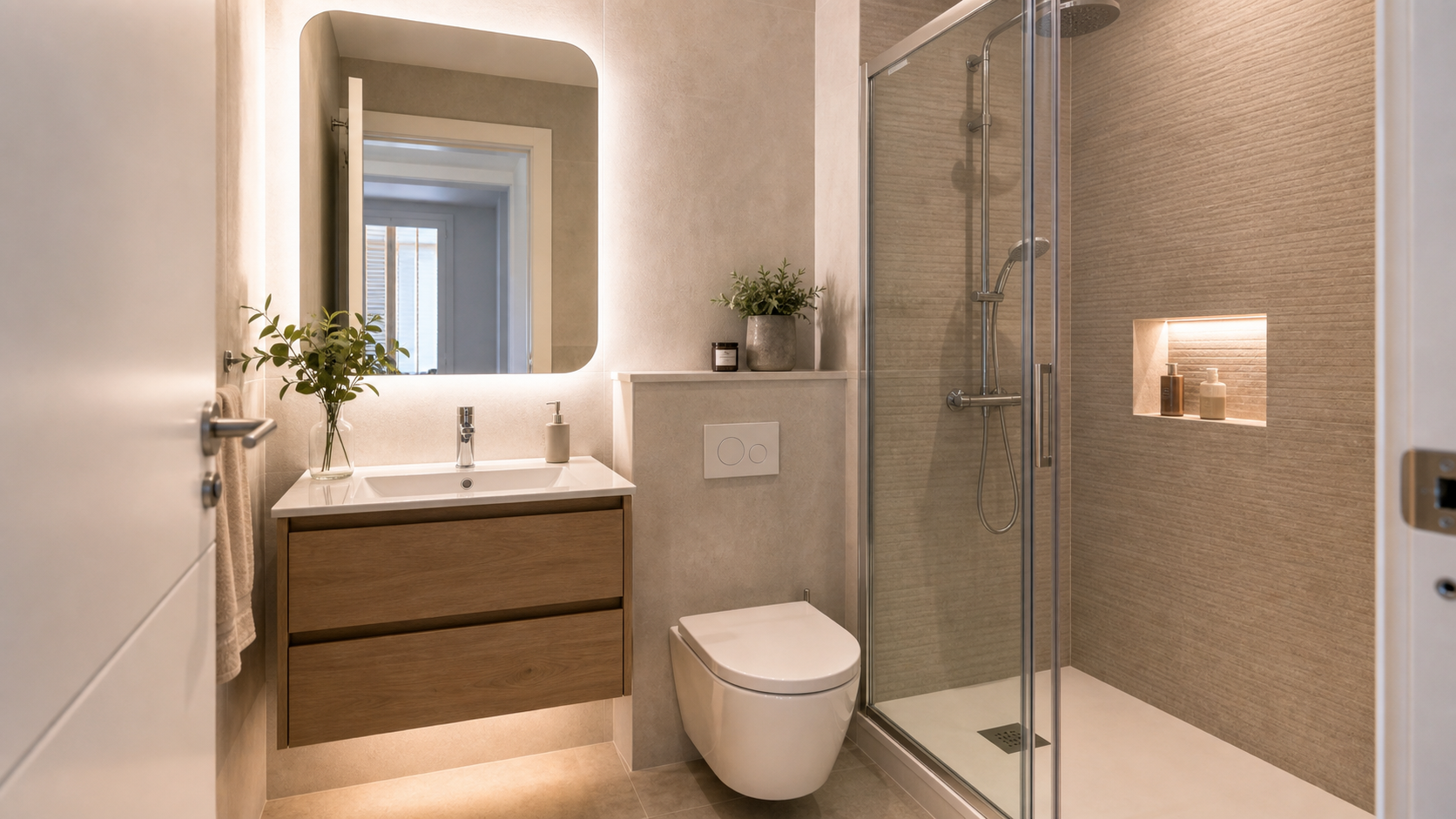
Small bathroom
Three or four square metres in a flat. The tricky part: making it feel open and using every corner without cramming it.
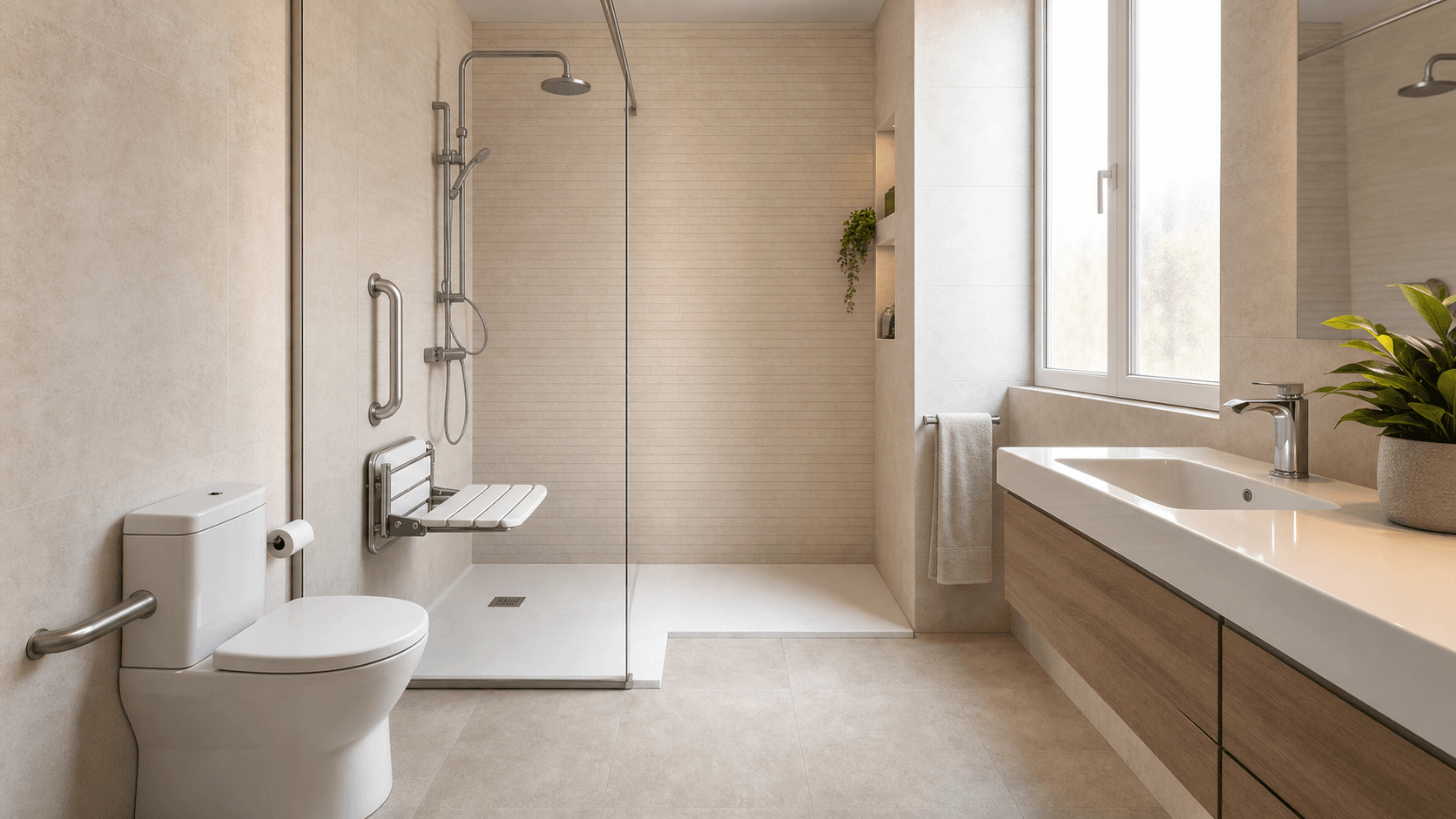
Accessible bathroom
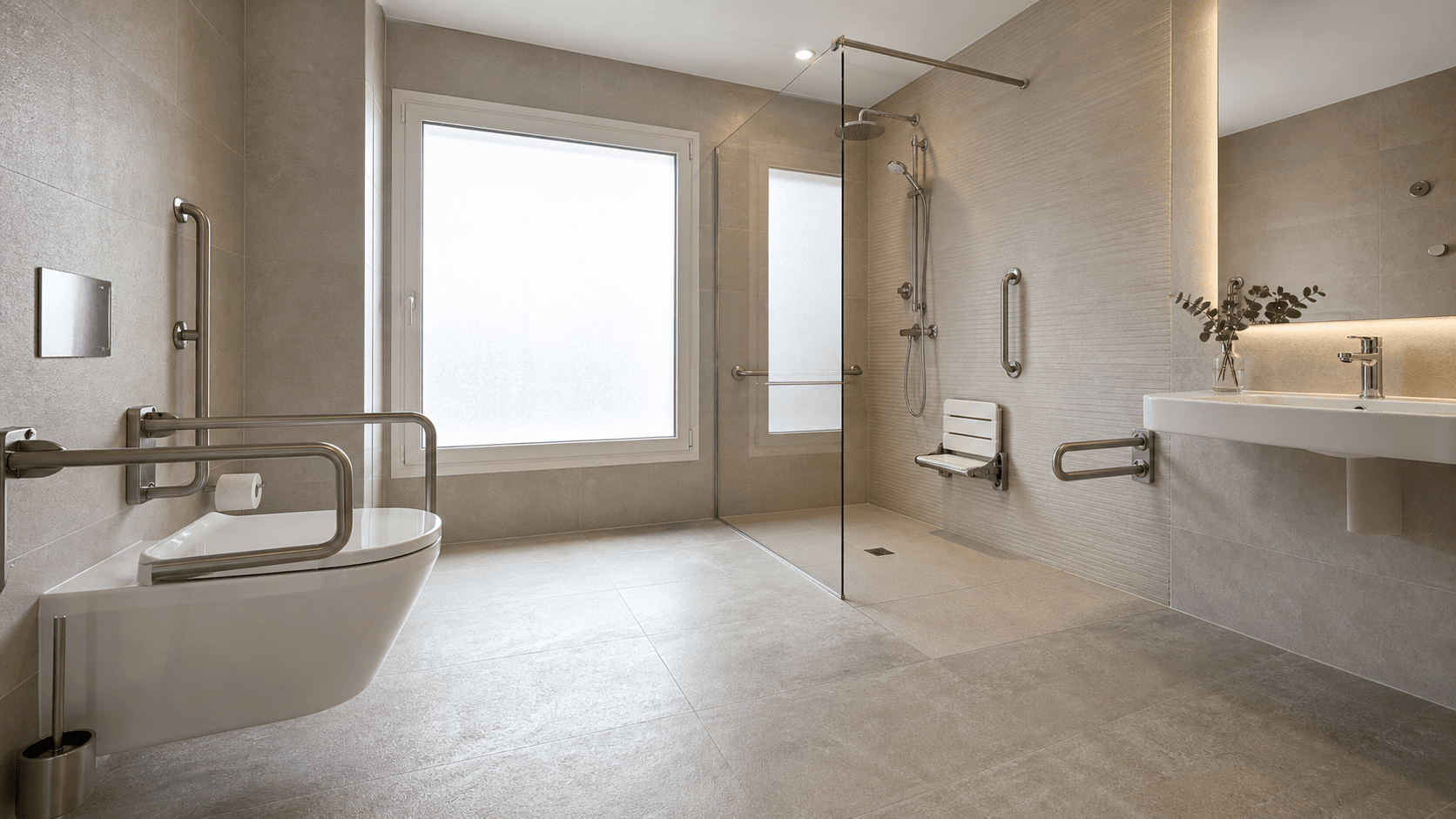
Adapting it for a parent or for someone with limited mobility. The tricky part: a level shower, grab rails and a floor that grips.
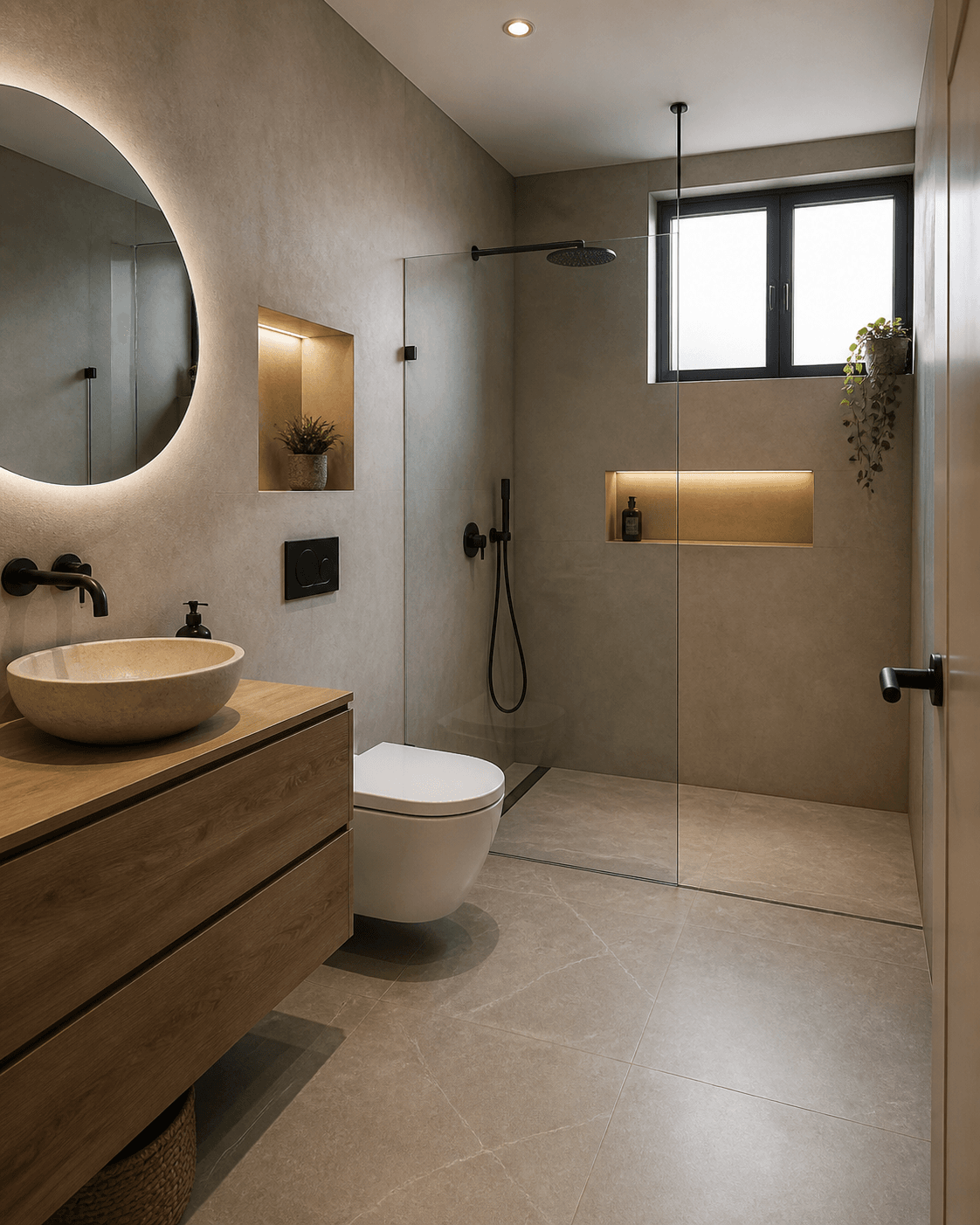
Complete refurbishment
Renewing the whole room, old or simply dated. The tricky part: checking the services and choosing finishes that last.
03 The one that pays for itself
Swapping the bath for a shower: the renovation that pays off most
By a distance, this is the bathroom job we are asked for most often, and there is good reason for it. Putting a flush-fitted tray where the bath was makes the room safer — the step that causes so many falls simply disappears — larger to the eye and far easier to live with. In most bathrooms it is a matter of days, with nothing else in the room touched.
The part that matters is not the tray you can see but what goes under it. The waterproofing goes down before anything is fitted, and the fall towards the waste is formed properly: that is what keeps water off the structure and out of the flat below. Only then do we choose the tray itself — resin, porcelain or mineral-filled, always anti-slip — and the screen, cut to the opening you have.
If the reason for the change is age or mobility rather than looks, the same job doubles as the first step towards a barrier-free bathroom, and we build it that way from the start.
04 The investment
How much a bathroom renovation costs in Valencia
No two bathrooms are the same, but market ranges give you your bearings before anybody quotes. Treat these as a market guide, not a quote: the real figure comes after the site visit.
| Type of renovation | Market guide | What it usually covers |
|---|---|---|
| Bath swapped for a shower | ≈ €1,500–€3,500 | Bath removed, waterproofing, flush-fitted tray, made-to-measure screen and taps, with the rest of the room untouched. |
| Complete bathroom · entry level | ≈ €4,000–€6,500 | Everything renewed with standard sanitaryware, straightforward tiling, one unit and a standard tray, keeping the layout as it is. |
| Complete bathroom · mid range | ≈ €6,500–€10,000 | Wall-hung sanitaryware, thermostatic taps, good large-format porcelain, a unit made to measure and services renewed. |
| Complete bathroom · high end | ≈ €10,000–€16,000+ | New layout, microcement or large-format walls, twin basins, a built-in shower, heating and lighting drawn for the room. |
Market ranges for Valencia in 2026, for a bathroom of roughly 4–6 m². They are here to give you your bearings and nothing else: no figure on this page is a quote. What your own room costs turns on its size, on the finishes you pick and on what the walls turn out to be hiding.
What moves the price
Four things, in this order: the square metres; whether the layout changes, because moving the shower, the toilet or the basin drags the plumbing with it; the level of sanitaryware, taps and wall finishes; and the state of the existing pipework. Taking a bath out is not the same conversation as rebuilding the room around a new plan.
So rather than a catalogue price that turns out not to fit your room, what you get from us is a fixed figure, written down after the site visit and broken out trade by trade. Sign it and that is what you pay; if something extra comes up, it is costed and agreed on paper before anybody starts it. The whole sequence, from that first visit through to the final check, is laid out in how we work.
Where to spend, where to hold back
How to keep the cost down without cutting what matters
Saving on a bathroom is not a matter of buying the cheapest of everything. It is knowing which items you can trim and which ones you must not touch. After 35 years of opening up other people’s bathrooms, this is the advice we give anyone working to a firm figure who does not want to regret it.
Never cut what you cannot see. The waterproofing, the supply pipes and the waste are the invisible half of the room. Saving there is the most expensive decision available to you: a leak means breaking up tiling and a tray you have already paid for, and, in a flat, an awkward conversation with the neighbour below.
Trim the sanitaryware and the furniture instead. There are trays, units and taps at sensible money that give an excellent result, and the treat — a rain head, a special wall finish — can always wait for a second stage once the room is sound.
Keeping the layout saves a great deal. Leave the shower, the toilet and the basin where they already are and most of the plumbing bill goes away. Moving them to the other wall costs real money. Sometimes it is worth it; it is just better to know that before you decide, not afterwards.
How you follow the work
Your bathroom, quoted and run in English
Batecs is a Spanish building company: Spanish team, Spanish suppliers, Spanish rules. English is what everything reaching you is written and spoken in — the quote, the decisions and the paperwork.
- One English-speaking point of contact. Whoever measures the room on the first visit is whoever picks up the phone on the day you get it back. When a tray turns up cracked, or the wall opens and there is a surprise behind it, you hear it from that person the same day, not a fortnight later.
- The town hall side is ours, not yours. A bathroom that keeps its layout is usually covered by a responsible declaration (declaración responsable, the lighter route for smaller work); move a soil pipe or touch anything structural and it becomes a building licence (licencia de obra). We work out which of the two your job needs, we put the file together and lodge it, and before anything is signed we take you through it in English, line by line.
The documents themselves stay in Spanish, of course — a Valencian town hall issues them in Spanish and nobody in this trade can change that. What we can do is make sure you know exactly what each line commits you to first. The longer version, including what is worth checking before you let anybody loose on a house in Spain, sits on our page about English-speaking builders in Valencia.
Want to know what your own bathroom would cost?
Send us the measurements, a photograph and what you would like to change. We come and look at it, and the itemised price follows in writing. Every enquiry is answered within 24–48 hours, and nothing is signed at that stage.
Price up my bathroom05 The Batecs method
How we handle your bathroom renovation
Six stages, in an order chosen for one reason: to keep the number of days you have no bathroom as low as it can go.
Visit and measure-up
We look at the state of the room, take the measurements and listen to what you want out of it. No charge and no obligation.
Proposal and finishes
We settle the layout, the sanitaryware and the wall finishes, and put a fixed quote behind them, itemised line by line.
Ordering
Tray, screen, sanitaryware and tiles are ordered and delivered before we touch anything, so nothing stalls half way.
Coordinated build
Strip-out, plumbing, waterproofing, tiling and fitting, in that order, with our own team and one site manager on it.
Checks
We test the seals, the falls and the joints, and every water and light point, before the screen goes in.
Handover
You get the room back clean, sealed and ready to use, with nothing left on a list for later.
That is the whole point of the coordination. We do not start the strip-out until the materials are standing in the hallway — particularly when it is the only bathroom in the house and there is nowhere else to go.
06 The decision
Bath or shower: which suits you
There is no single right answer, but in a bathroom used every day the shower usually wins. Here is what each one gives you and what it takes away.
Safer and more spacious
- No step to climb over, which matters more every year.
- Gives back floor and makes a small room read as larger.
- Quicker to clean and easier to use day to day.
- The starting point for a barrier-free bathroom later.
- You give up the long soak in the bath.
For soaking and small children
- You keep the long soak at the end of a bad day.
- Far easier for bathing small children.
- Takes up room and closes a small bathroom down.
- The step becomes a slip risk as the years go on.
- With two bathrooms, keeping a bath in the second one makes sense.
What we tend to advise: if it is the bathroom in daily use, put a shower in it. If you have two and you enjoy a soak, keep the bath in the spare one and give the everyday room the walk-in shower. We will weigh it up against your actual house on the visit.
Two very common cases
Accessible bathroom and small bathroom: how we solve them
Two of the enquiries that reach us most often are not about looks at all. They are about need: adapting a bathroom for an older relative, and getting a decent room out of three or four square metres. Each has its own rules.
An accessible bathroom adapted for older people
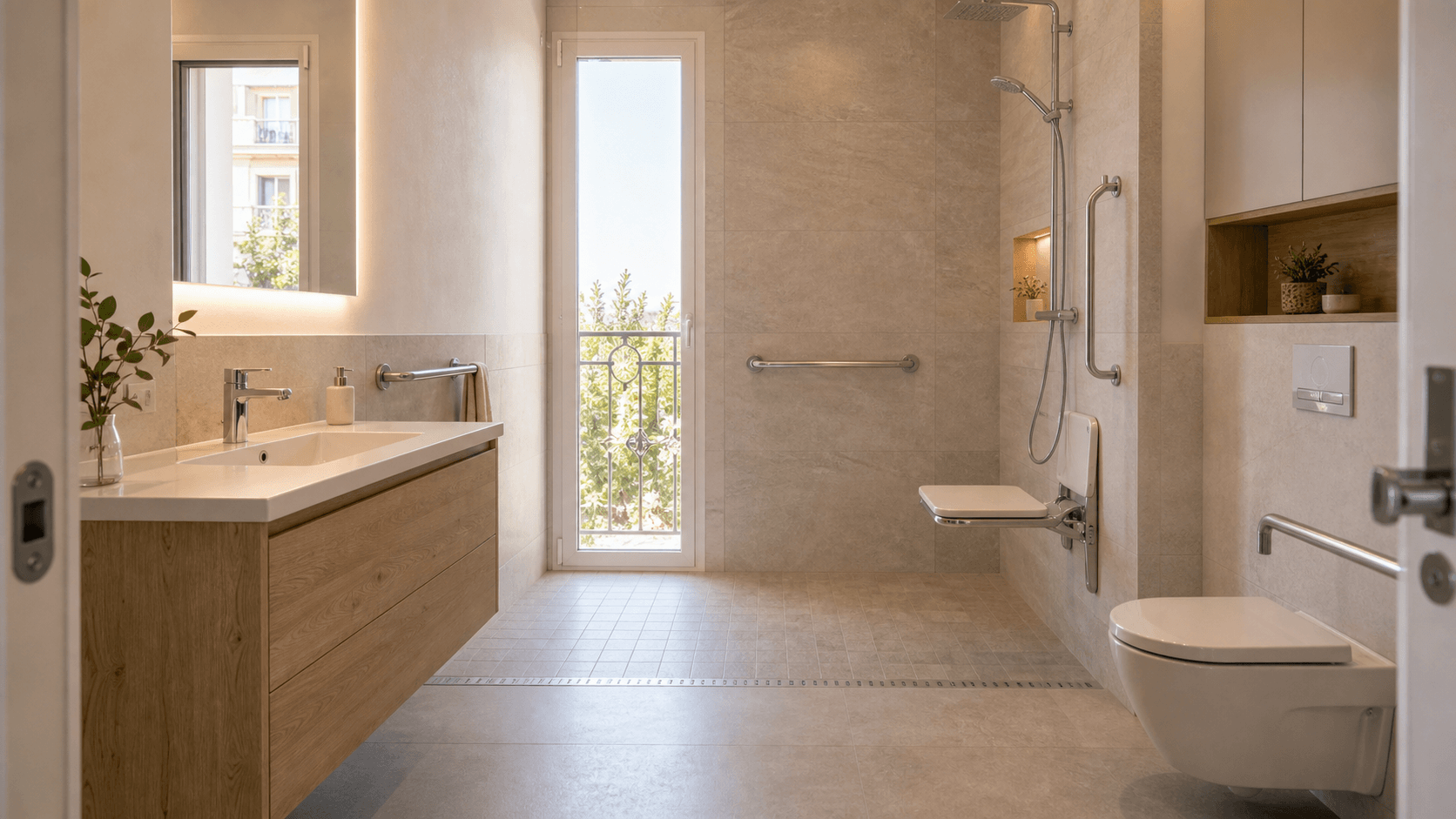
An accessible bathroom does not have to look clinical. Done well it is safe and good-looking at once. The essentials are a level shower flush with the floor, an anti-slip floor, grab rails fixed into something solid, a fold-down seat and, where it is needed, a toilet at a comfortable height and enough clear floor to turn in. Building all of that into an ordinary renovation costs very little extra and saves a second job in a few years’ time. If the idea is to make the whole house work rather than one room, we handle it inside a full home renovation.
Small bathroom: gaining space without losing comfort
Flats around Valencia are full of bathrooms of 3 or 4 m², where every centimetre is spoken for. Space is won with things that genuinely work: a flush-fitted tray that runs the floor through, wall-hung sanitaryware that leaves the floor visible, a clear glass screen instead of a curtain, large-format tiles with few joints, and storage lifted off the ground. The trick is not fitting more in. It is clearing the floor and the line of sight so the room can breathe.
07 Our work
Three bathrooms, three different problems
A sample of the bathrooms we take back to brick and rebuild across Valencia and the Camp de Túria.
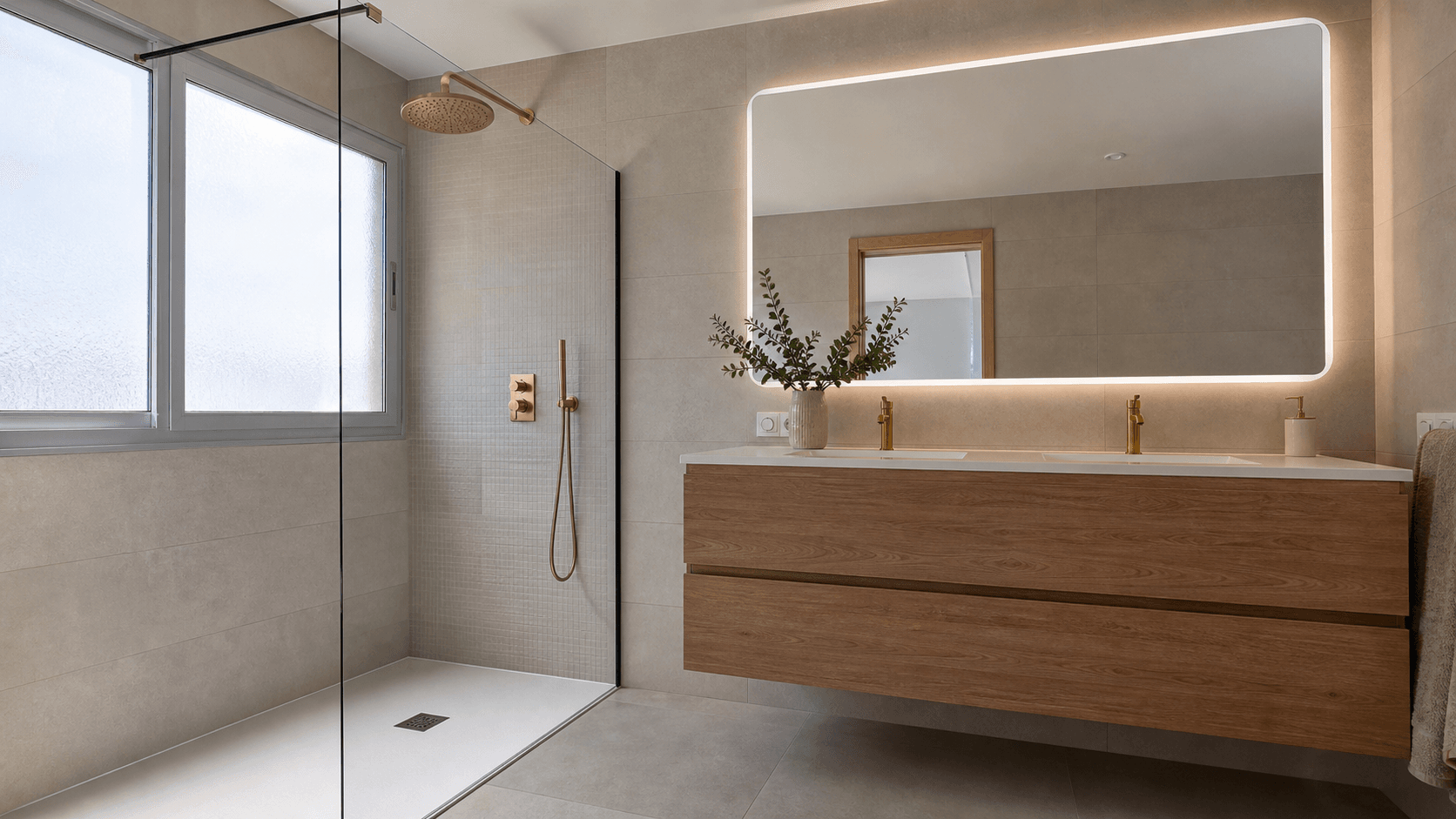
A 1980s bathroom in a flat in the Eixample
The bath came out and a flush-fitted tray went in, with dark large-format tiling, a wall-hung basin and a screen cut to the opening. We renewed the supply pipes and redid the waterproofing while the walls were open, which is the only sensible moment to do it.
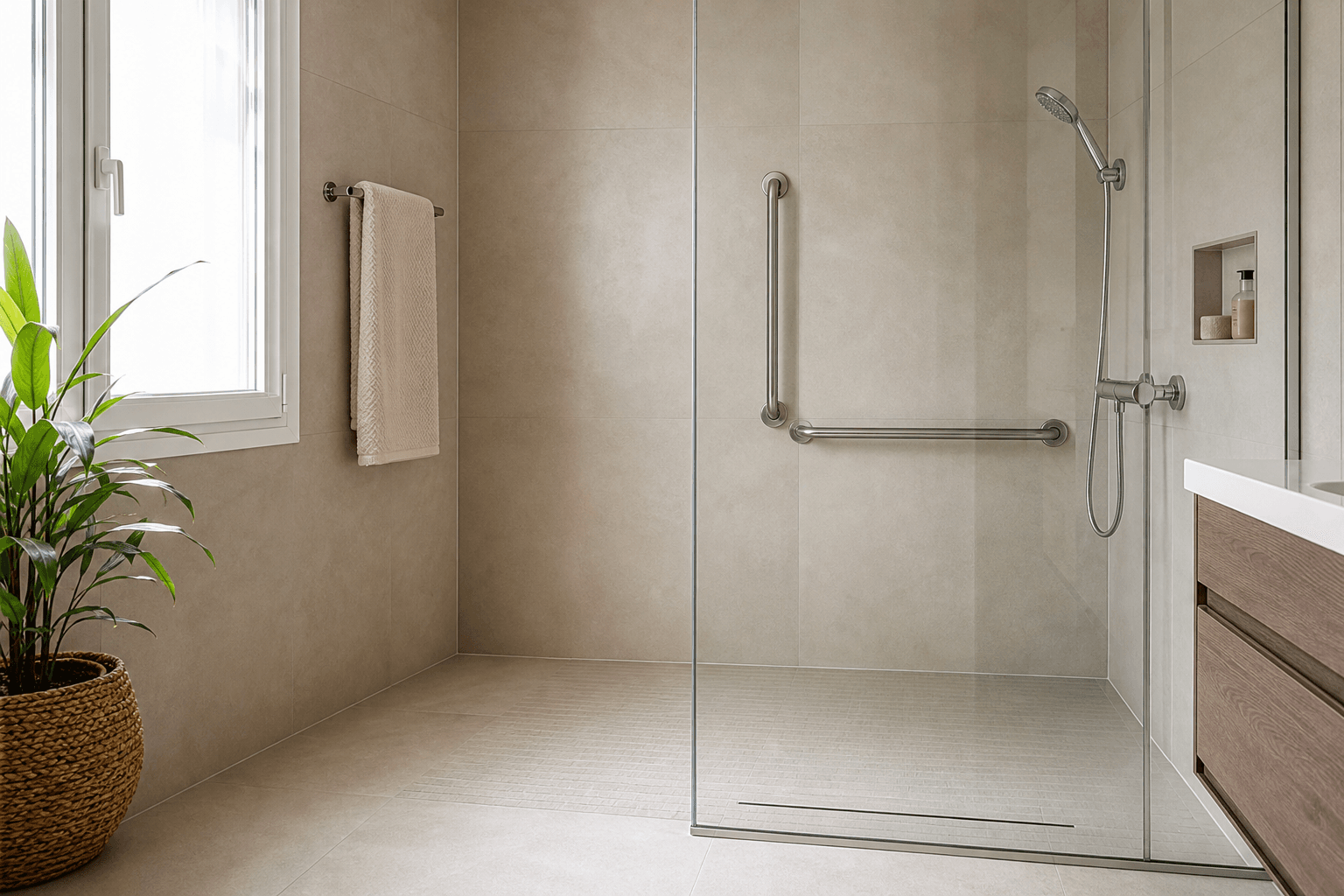
A bathroom with a coloured glass wall
A room with some character to it: a coloured glass wall as the one bold gesture, a generous shower behind a fixed screen and thermostatic taps. We took particular care over the joints and the extraction, so that a finish this striking does not turn into a damp problem two winters later.
A family bathroom that kept its bath
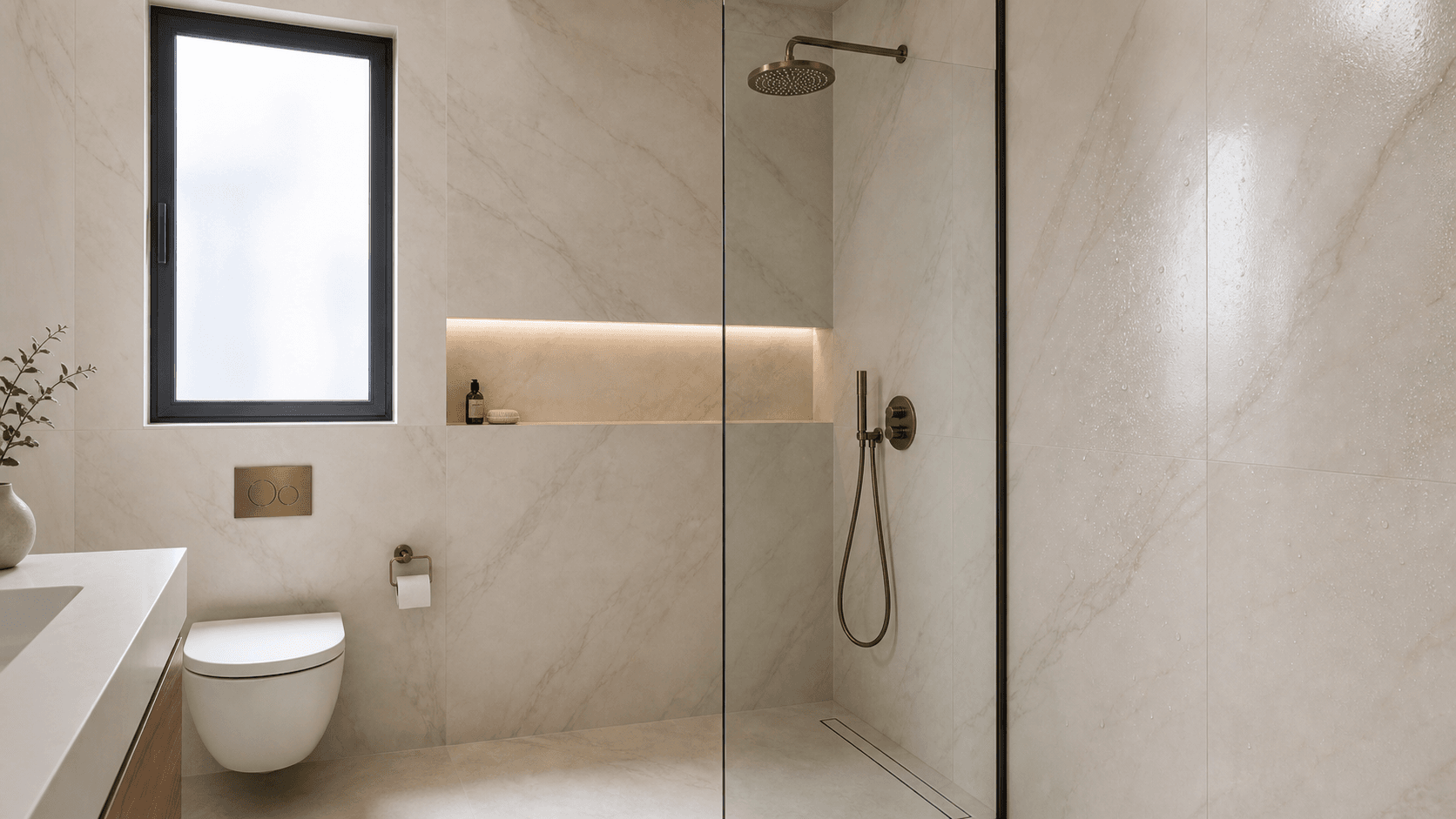
In a main bathroom with room to spare we kept the bath for the children and added a separate shower alongside it, all in beige large-format porcelain. The answer for a family that was not willing to give up either the soak or the quick shower before work.
There is more finished work in our gallery of projects, alongside kitchens, villas and whole houses.
08 Finishes
Materials and sanitaryware: what really makes the difference
We steer you towards materials that earn their place — not only for how they look, but for how they wear, how they clean and how safe they are underfoot.
Shower trays
Resin, porcelain or mineral-filled, level with the floor and anti-slip. Cut to size, so they fit the room you have rather than the room the catalogue assumed.
Screens
Tempered glass made to measure, fixed or folding, treated against limescale. Clear rather than frosted, because that is what makes a small bathroom look bigger.
Wall-hung sanitaryware
Wall-hung toilets and basins on a concealed frame: the floor stays visible, the room feels larger and there is nothing awkward to clean around.
Thermostatic taps
They hold the temperature you set instead of swinging hot and cold when somebody runs a tap elsewhere. More comfortable, safer with children, and less water down the drain.
Wall finishes
Large-format porcelain and seamless microcement: fewer joints, less mould to scrub and a finish that still looks current in ten years.
Accessibility
Grab rails, fold-down seats, floors that grip when wet and level showers, so the bathroom works at seventy as well as it does at forty.
What you cannot see
Waterproofing and ventilation: the difference between a good bathroom and one that fails
Almost nothing goes wrong in a renovated bathroom because of the toilet. It goes wrong because of two things nobody can inspect once the job is finished: waterproofing skimped under the tray and behind the tiles, and ventilation that was never sized for the room. We treat both as core work, which is precisely why they are the two items we will not let you cut.
Before a single tile goes up we lay a waterproofing membrane or resin and form the fall towards the waste, so the water that inevitably works through the joints has somewhere to go that is not your structure or your neighbour’s ceiling. Ambient humidity gets the same treatment: a room without a window needs extraction sized properly and ducted to the outside, or the black marks are back in the joints within a couple of winters.
And if the damp is coming from somewhere else entirely — a leak, water arriving from the flat above — we find the cause and repair it before we close anything up. Covering a patch simply moves the problem a year down the road, and you would be paying twice for the same wall.
The same eye goes into everything you do see: materials, light and layout drawn by the people who then build them →
09 Before you start
Mistakes worth avoiding when renovating the bathroom
- Skimping on the waterproofing or the fall of the tray, which is where every leak starts.
- Treating ventilation as optional, above all in an internal bathroom with no window.
- Starting the strip-out before the tray, screen, sanitaryware and tiles have been measured and ordered.
- Leaving tired supply pipes in place purely to avoid breaking up while the walls are already open.
- Moving the shower or the toilet without asking first what the extra plumbing adds to the price.
- Choosing a floor that has no grip when wet, or sanitaryware with corners nobody can reach to clean.
Gallery
Bathrooms renovated by Batecs
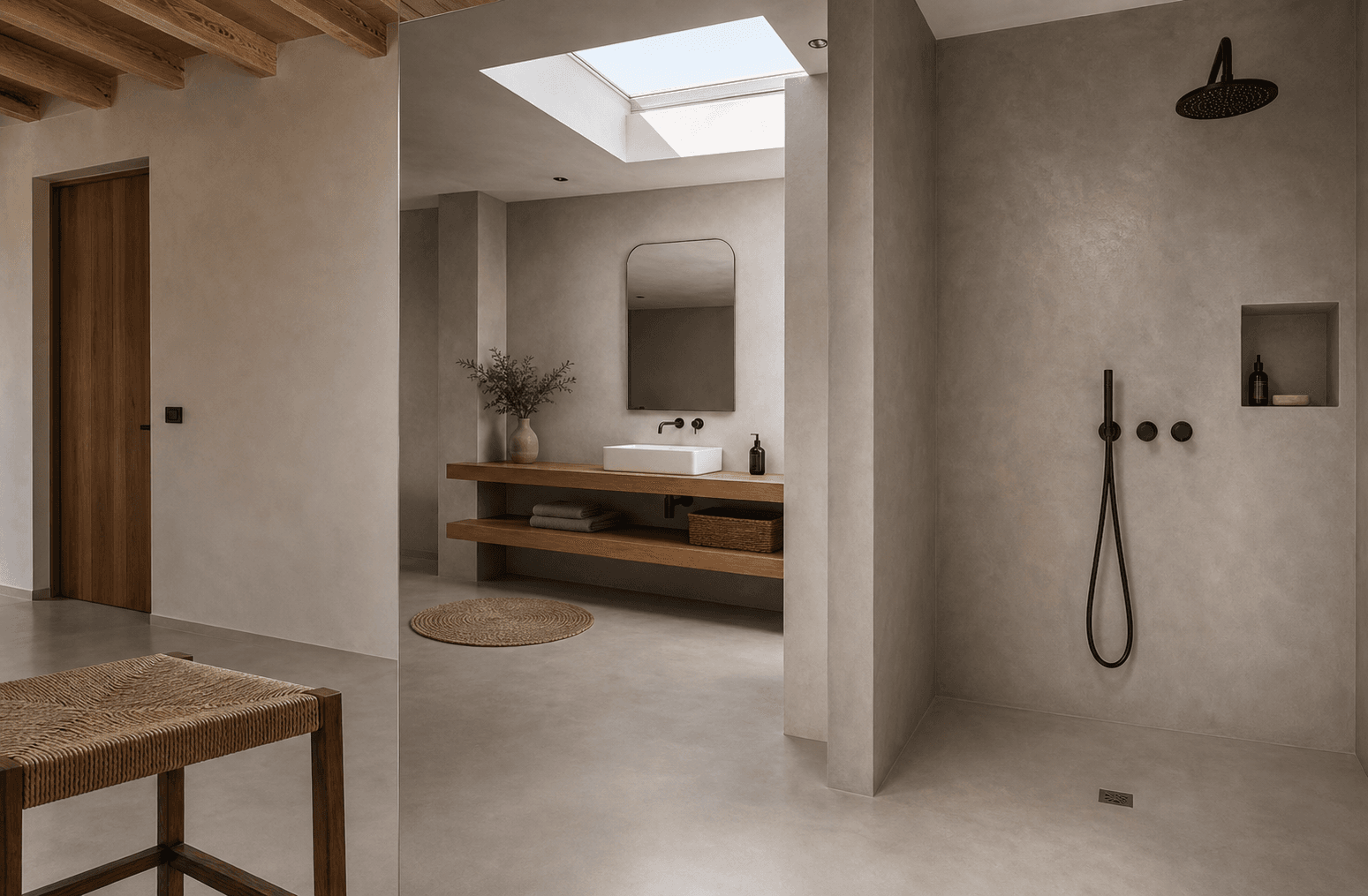
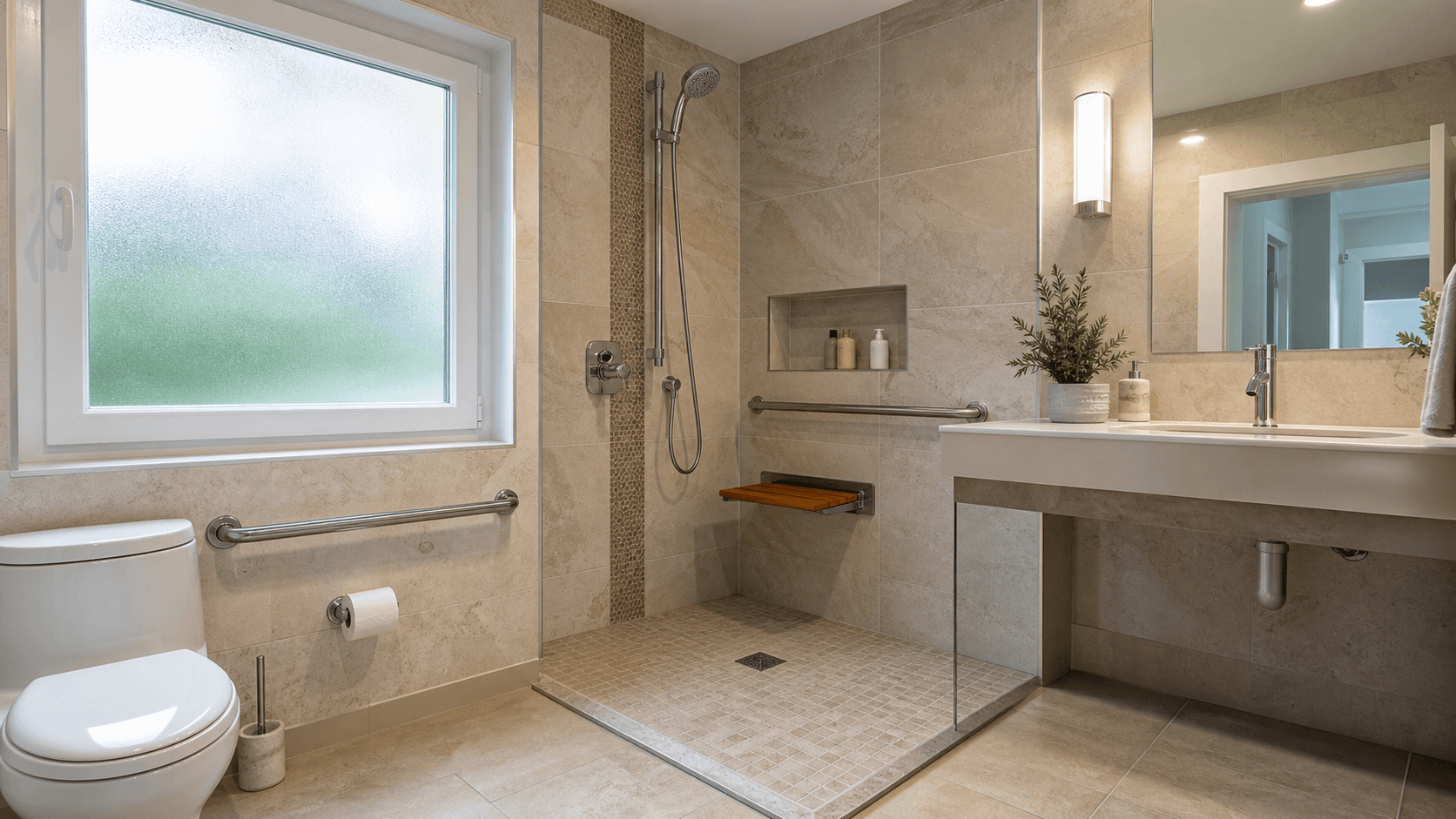
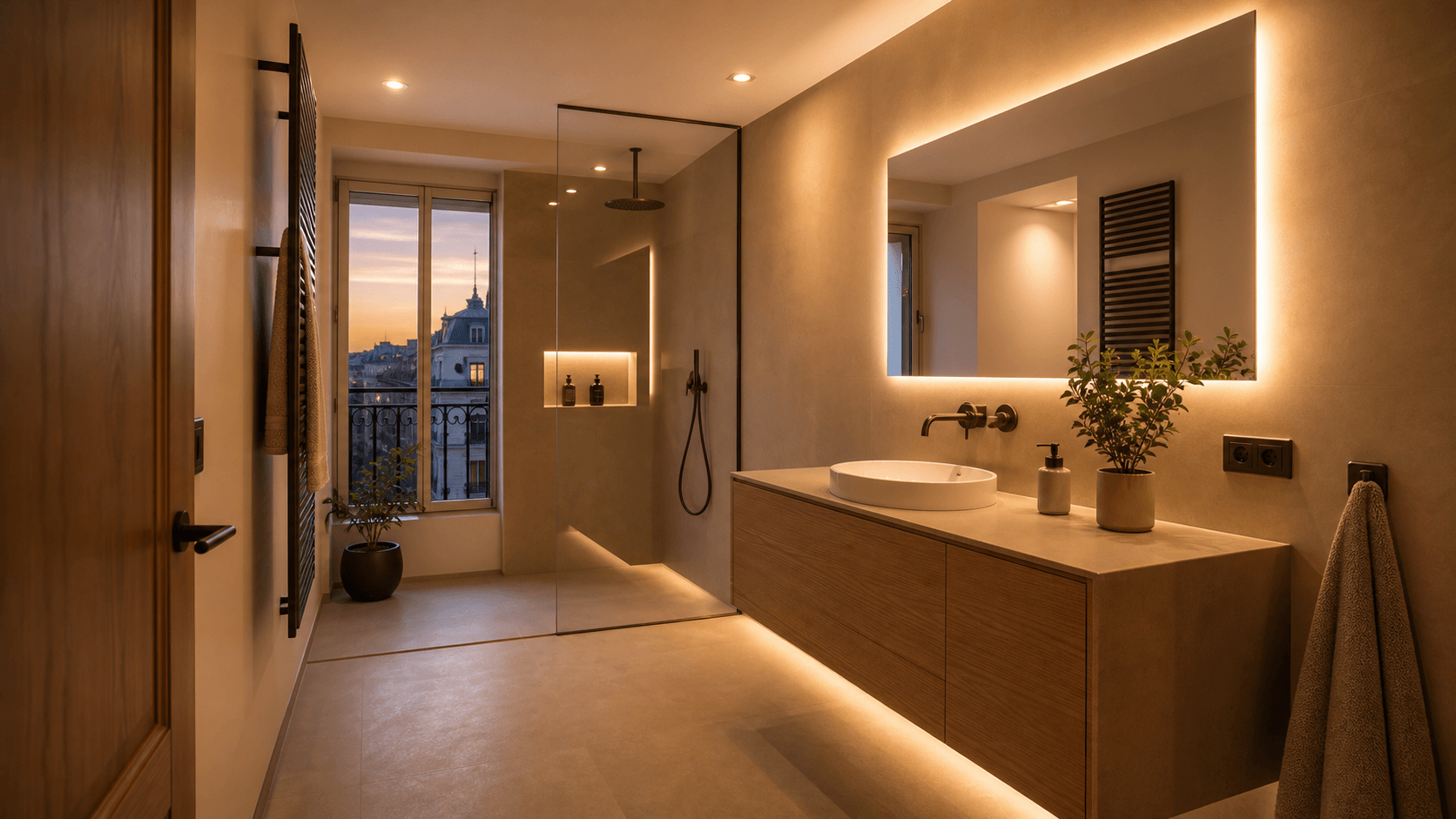
The range of what we do: from a tray dropped in where the bath was to a room rebuilt from the waste pipe up.
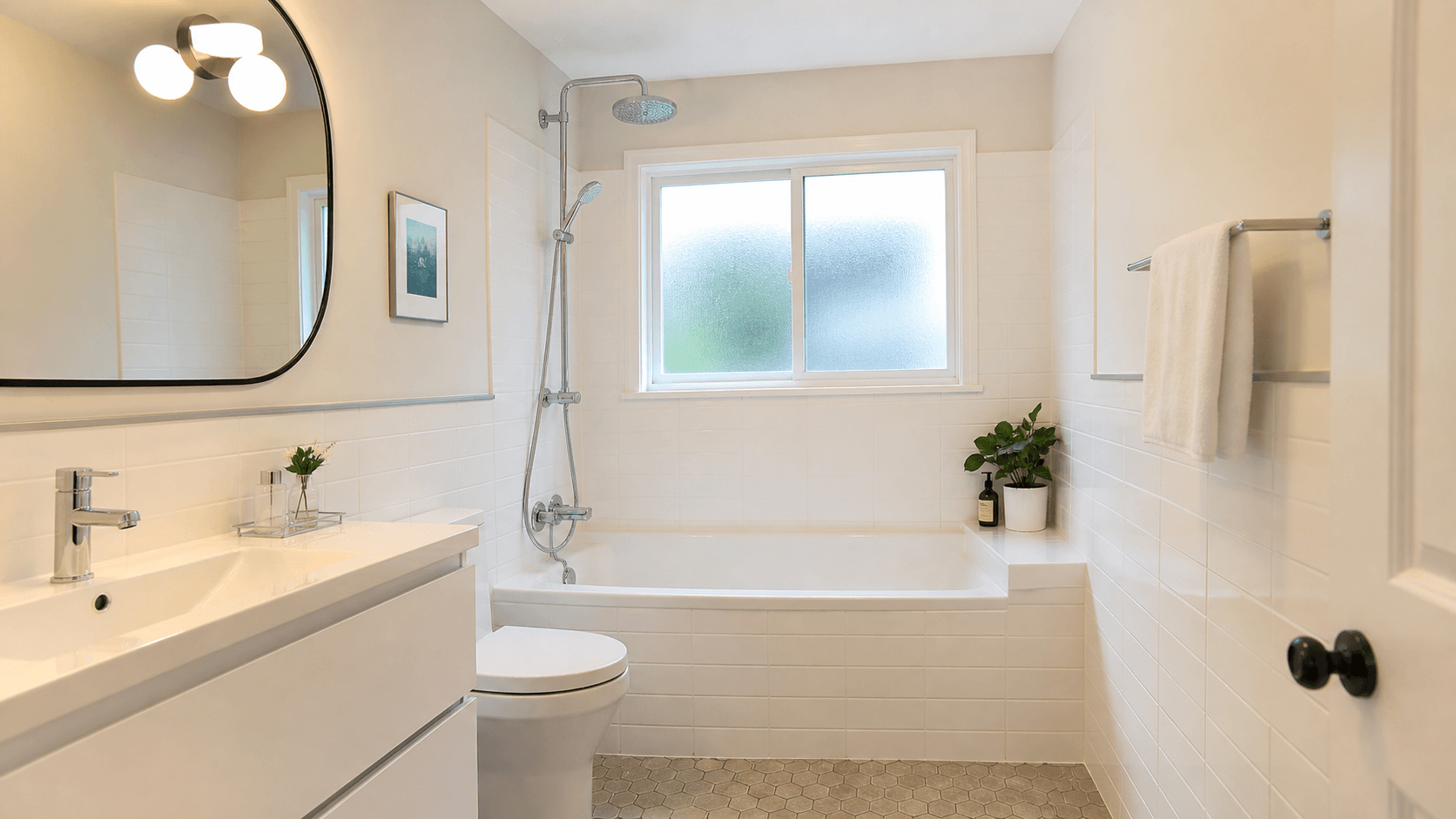
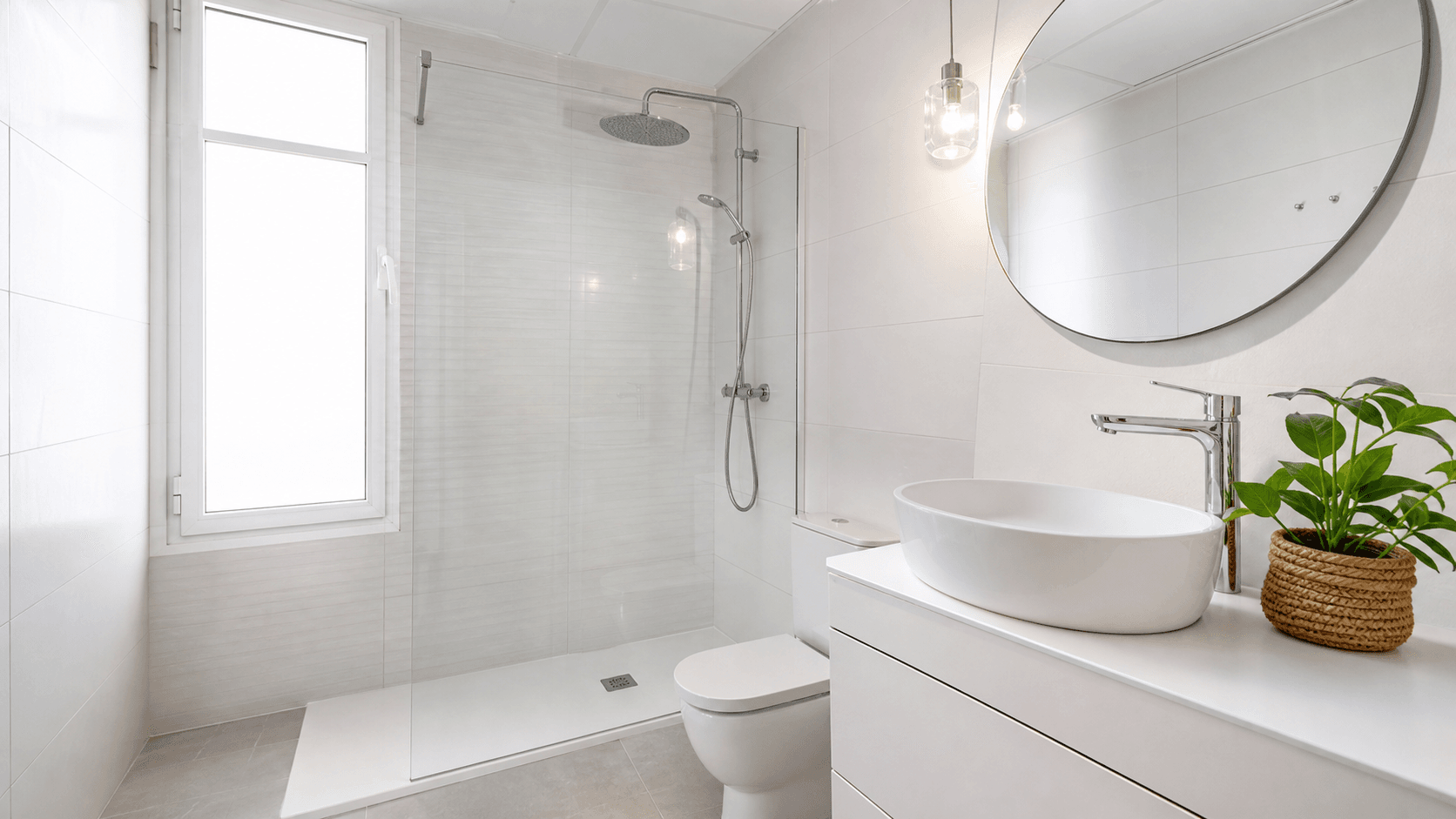
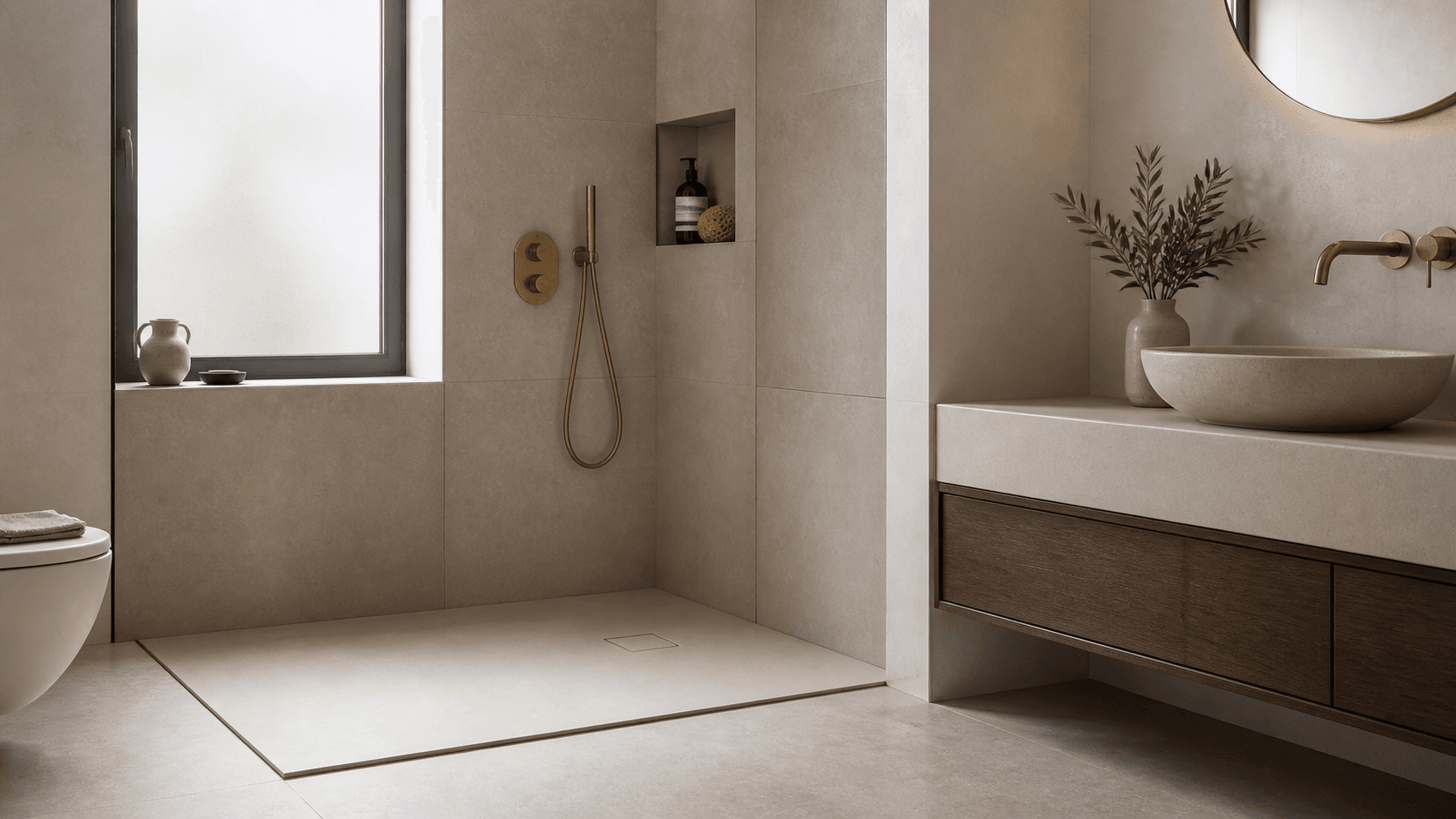
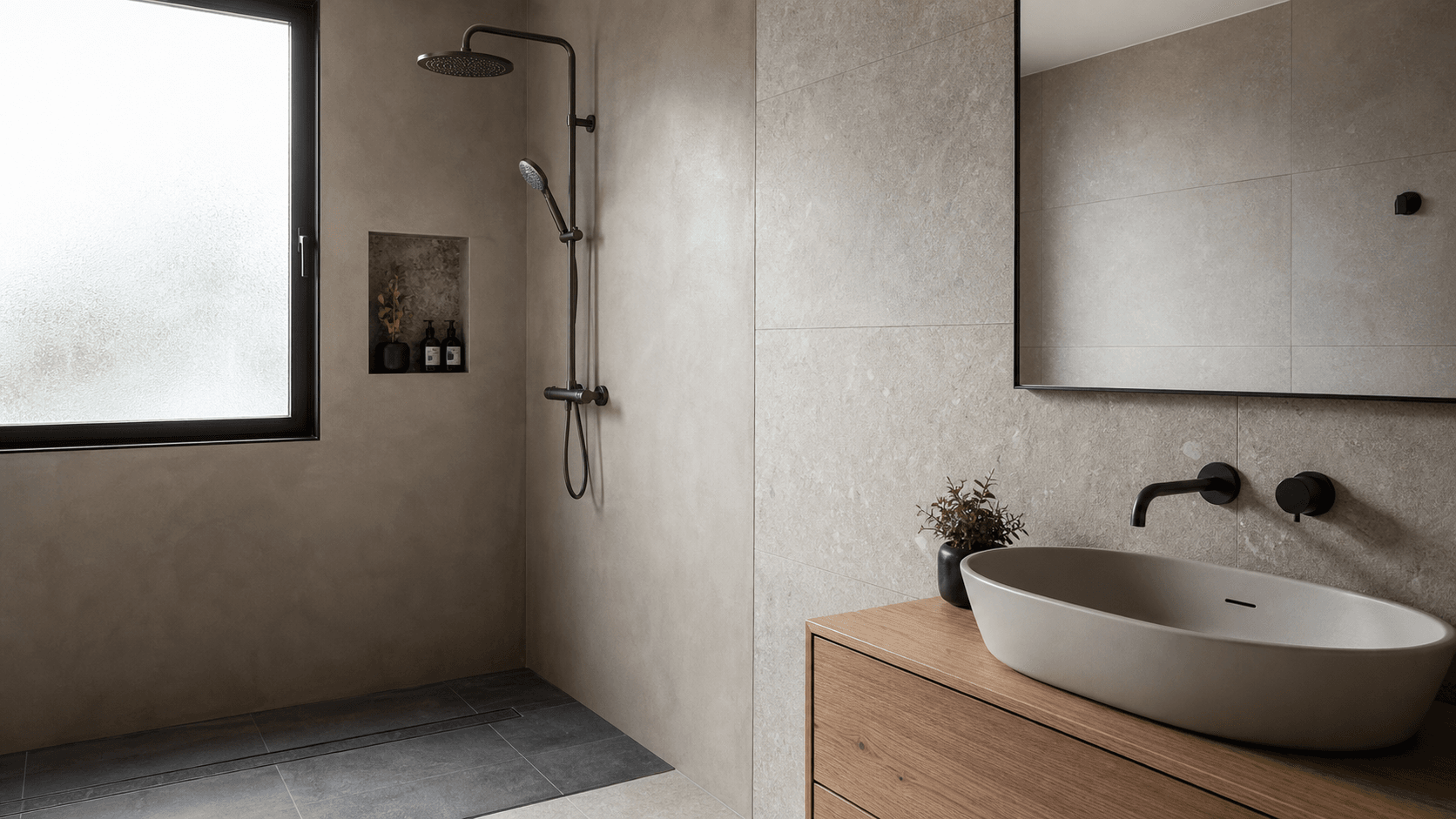
← Swipe to see more examples →
Related projects
Bathroom projects you can look through
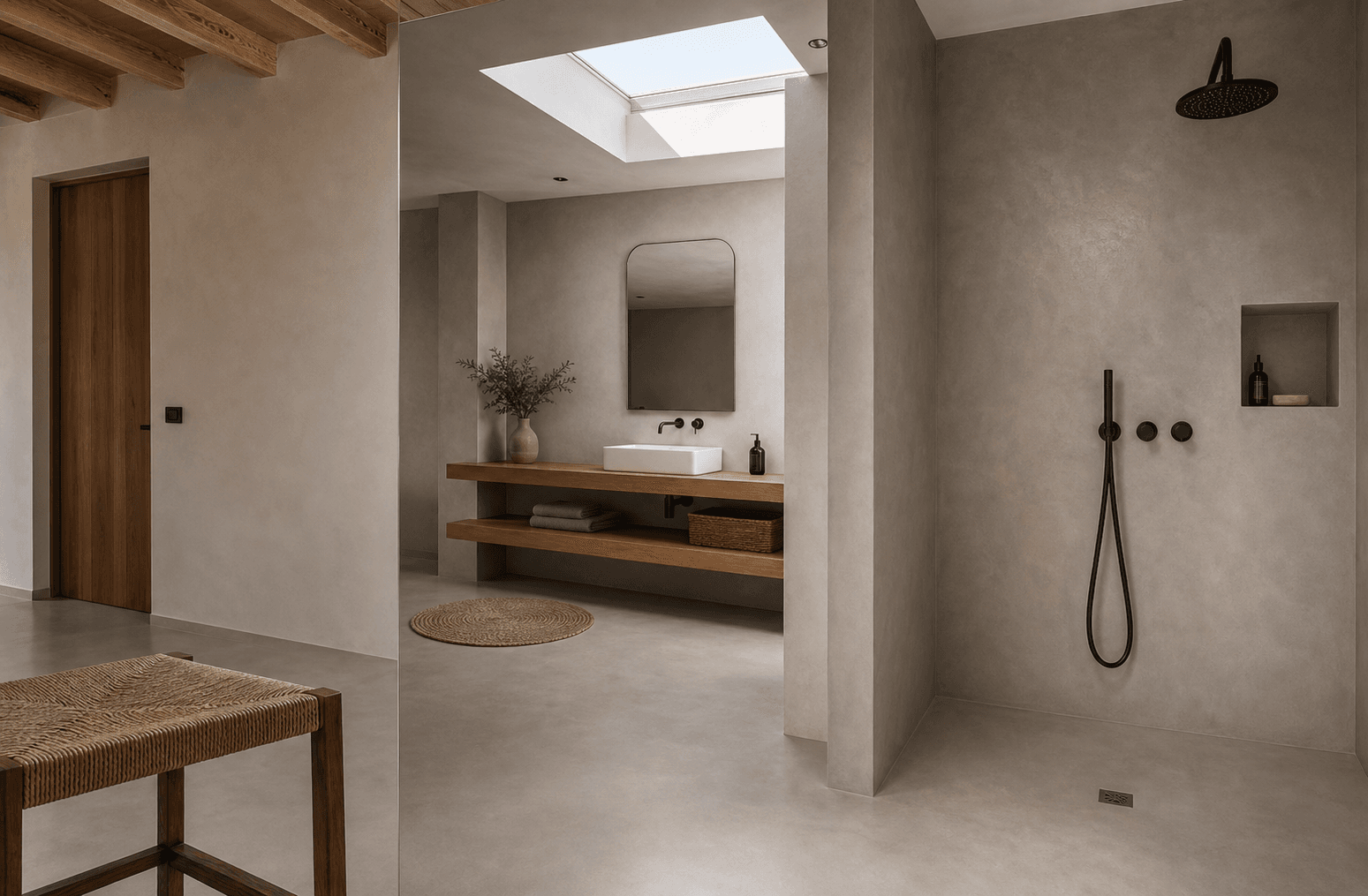
Open any of them to see how the room was put together.
Coverage
The towns where we renovate bathrooms
Our yard sits in La Eliana, which puts most of the Camp de Túria within twenty minutes of the van, and the estates around the international schools closer still. Valencia city and l’Horta Nord take up the other half of the week.
Where most of our bathrooms are
And the towns around them
Questions we get asked
Frequently asked questions about bathroom renovations
How much does it cost to renovate a bathroom in Valencia?
As a market guide rather than a quote, taking a bath out and putting a shower in generally lands between €1,500–€3,500, while a complete bathroom runs from around €4,000–€6,500 at entry level up to €10,000–€16,000 or more at the top end with a new layout. What decides it is the size of the room, the level of sanitaryware and wall finishes, and how much of the plumbing has to be renewed. After the site visit you get a fixed quote, itemised trade by trade, with no vague line saying “sundries”.
How long does it take, and how many days will I have no bathroom?
Swapping a bath for a shower is a matter of days. A complete bathroom is usually one to two weeks, depending on how far the work goes. We order the tray, the screen and the sanitaryware first and do not start the strip-out until everything has arrived, which is what keeps the room out of use for as short a time as possible — and it matters most when it is the only bathroom in the house.
Can you swap my bath for a walk-in shower?
Yes, and it is one of the best-value jobs we do. The bath comes out, we waterproof, form the fall to the waste and fit a flush-fitted, anti-slip tray with a screen cut to the opening. You gain safety, floor space and a room that feels bigger, usually inside a week.
Can a bathroom be renovated without building work?
There are low-impact options — a tray fitted over the existing one, panels over old tiles — and they suit some very specific situations. But a bathroom is not genuinely renewed without touching the waterproofing or checking the pipework, and the cheap route tends to be a short-lived one. At the visit we will tell you honestly which of the two your bathroom needs, even when the honest answer is the smaller job.
Do you do adapted bathrooms for older people?
Yes. We build accessible bathrooms with a level shower flush to the floor, an anti-slip floor, grab rails fixed into something solid, a fold-down seat and, where it is needed, a toilet at a comfortable height with enough clear floor to turn in. It can be safe and good-looking at the same time; nothing about it has to look clinical.
How do you gain space in a small bathroom?
With a flush-fitted tray that carries the floor through, wall-hung sanitaryware that leaves the floor in view, a clear screen rather than a curtain, large-format tiles with few joints, and storage lifted off the ground. The aim is to clear the floor and the line of sight, not to squeeze more objects into the room.
How do you stop damp coming back after the work?
Waterproofing laid properly under the tray and behind the tiles, the fall to the waste formed correctly, and extraction sized for the room. Those three are core work, not extras. Where there is already damp arriving from somewhere else, we track down the cause and repair that first, before anything is closed up.
What do I do about a bathroom with no window?
An internal bathroom needs a properly sized extractor ducted to the outside, not one that simply stirs the air around. Pair that with low-joint finishes — large format, microcement — and the black marks in the grout do not come back. It is dealt with as part of the renovation, not sold to you afterwards as an upgrade.
What paperwork does a bathroom renovation need?
It depends on what you are changing. A bathroom that keeps its layout is normally covered by a responsible declaration or a works notification, depending on the town hall. Change the layout, or touch anything communal or structural, and it moves up to a building licence. We work out which one applies, prepare the file, submit it and explain to you in English what it says. Timescales vary from one town hall to the next, so we confirm with yours rather than promise you a date.
Do I need permission from the community of owners?
In a block of flats, quite possibly. Work inside your own four walls is generally yours to decide; anything that touches the façade, the windows, a terrace, the soil and waste stacks or any other communal element belongs to the comunidad de propietarios, the owners’ association that every Spanish block has. The request is made by you as the owner, in writing, to the president or the managing agent, and it goes before the owners’ meeting. Our part is to put the technical side of it in writing first — exactly what is being touched, how and for how long — so that what you submit is precise, and to answer any question the neighbours or the agent put to us. We will also tell you honestly when your job does not need to go anywhere near them. What we do not do is give you legal advice: for that you want your own lawyer or the managing agent.
Which materials last longest in a bathroom?
If the aim is not to do this twice: large-format porcelain or well-sealed microcement on the walls, a mineral-filled or porcelain tray, decent wall-hung sanitaryware and thermostatic taps. As a rule, whatever takes the most water is the last thing worth economising on. We will steer you by how the room gets used and by what you want to spend.
What happens if something goes wrong a year later?
We answer for the work carried out and for the materials, under current Spanish law. The part that matters in practice is who turns up if something needs looking at: the tiler and the plumber who built your bathroom are on our own payroll, so they come back and deal with it themselves rather than leaving you with a supplier’s telephone number.
Do you only do bathrooms, or the rest of the house too?
Both. We will happily do the bathroom on its own, and we will fold it into a renovation of the whole house if that is where this is heading. Plenty of clients do the bathroom and the kitchen in the same visit and save on the coordination, the deliveries and the mess.
Which areas do you renovate bathrooms in?
The city of Valencia, our own town of La Eliana, and everywhere across the Camp de Túria and l’Horta Nord. Most weeks that means Godella, Rocafort, Bétera, San Antonio de Benagéber and La Cañada, plus Paterna, Moncada, Alboraya, Llíria, La Pobla de Vallbona and Riba-roja de Túria.
In short
A bathroom renovation in Valencia renews the room from the waste pipe up — plumbing, sanitaryware, tray, screen, tiling, furniture and lighting — and treats the waterproofing and the ventilation as seriously as the part you can see. We build it with our own plumbers and tilers, swap the bath for a shower or adapt the room where that is what you need, and give it back ready to use with as few days out of action as the job allows. Everything you are asked to decide, sign or hand to the town hall reaches you in English.
As a market guide, a bath swapped for a shower sits around €1,500–€3,500 and a complete bathroom from €4,000–€6,500 at entry level to €10,000–€16,000 or more at the top end. Your own figure is fixed in writing after the site visit.
Let’s talk about your bathroom
Ask us to price your bathroom
Tell us what the room is now, what you want it to become and whether anybody has to keep using it while we work. We come and measure it ourselves, and you get an itemised written quote in English. There is nothing to sign and nothing to pay for the visit.
+34 632 224 555+34 962 742 447info@batecs.es
Ask for my quoteBathrooms are often the way in. We also take on kitchen renovations, full home renovations, villa renovations and partial renovations, and we draw the rooms before we build them in interior design. The method behind all of it is in how we work, and if your house is up in the school belt we are already working in La Eliana, La Cañada and Rocafort.